


Mini Golf Game - Putt Putt 3D
4.2446.00 Reviews
App Specs
- Version
- 4.0
- Updated On
- License
- Free
- Downloads
- 100,000+
- Developer
- ViralMedia-MLM
- Categories
- Sports
- Platform
- Android
Screenshots
 Analysis by AppCompare
Mini Golf Game - Putt Putt 3D caught my attention because it aims for a very focused kind of mobile play: pick up the phone, line up a shot, and enjoy a quick round without needing to learn a complicated sports simulation. After spending time with it, I found a game that works best as a casual multiplayer distraction, especially when I want something more social than a solo puzzle but less demanding than a full golf title. Its appeal is immediate, although its simplicity also defines its limits.
Developed by ViralMedia-MLM, this free sports game has a 4.2 average from around 2.1 thousand ratings and has passed 100 thousand installs. Those figures suggest that it has found a comfortable audience among players looking for a lightweight mini golf experience rather than a large, feature-heavy sports package. The Everyone content rating also fits its approachable presentation, making it suitable for family play and short sessions with friends.
Mini golf that gets to the point quickly
My first impression was that the game does not waste much time explaining itself. The basic idea is familiar: aim the ball, control the strength of the stroke, and try to finish each hole efficiently. That straightforward design is useful on a touchscreen, where an overloaded interface can make a simple game feel awkward. Here, the central action remains easy to understand from the beginning.
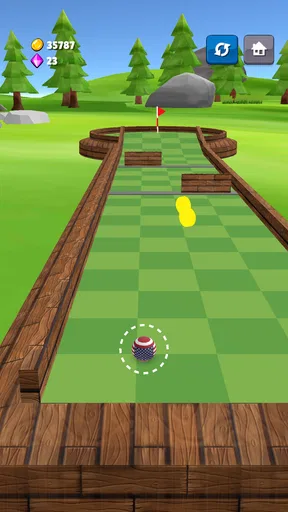
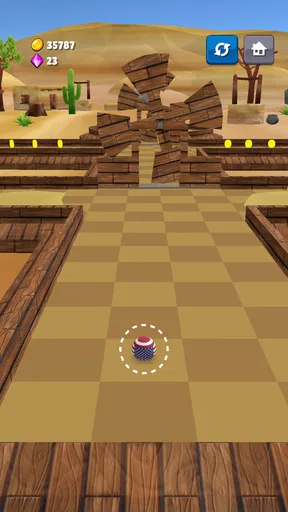
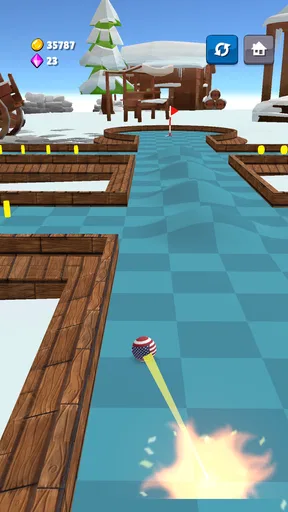
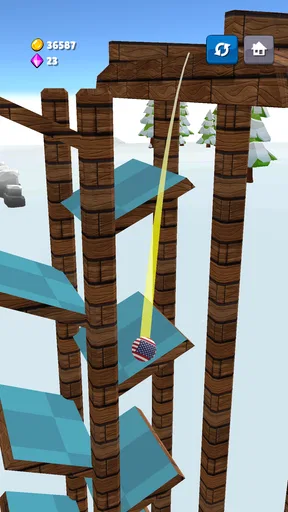
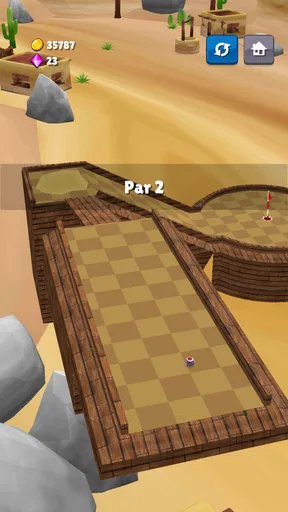
The three-dimensional presentation gives the courses more presence than a flat top-down board would. Even when the challenge is modest, seeing the ball travel through a shaped course makes each attempt feel like a small physical event. The important word is “small.” This is not trying to recreate every part of a real golf club or a professional tournament. It is built around the satisfying moment of judging a line and watching the result.
I especially liked how quickly it can fit into ordinary situations. A short break, a few minutes before leaving home, or a relaxed session on the sofa are all natural places for it. A friend and I could pass the phone around for a few holes without committing to a long evening. That convenience is one of its strongest qualities, because the game does not ask for the same attention as a more serious sports simulation.
The free entry point matters here. You can try the core experience without paying first, while optional in-app purchases cost $3.99 per item. For a casual title, that makes the decision simple: install it, see whether the aiming and pacing suit you, and only then consider spending anything. I would not treat the purchase options as a reason to start playing; the basic attraction should come from the mini golf itself.
A visual language built around the course
The art direction serves the playable space rather than competing with it. The course is the main character, and the three-dimensional view helps me read slopes, barriers, turns, and open areas as parts of a single visual problem. That is important in mini golf, because the environment is not just decoration. Its shape tells me where a shot might go and where a careless angle could send the ball.
Worth Reading Before You Choose

EA SPORTS FC Mobile 26 Is a Bigger Football Game, but It Takes Time

Flipboard Shows What News Apps Must Do Beyond the Feed

Switching to Android Auto Means Rethinking Your Driving Routine

Google Calendar Makes a Crowded Week Easier to Manage

Ludo King Makes the Most of the Minutes Between Plans

Baby Panda World Brings Quick Play to Modern Phones, but Its Game Library Feels Busy
This setting creates a pleasant middle ground between a realistic golf simulation and an abstract puzzle game. It feels like a miniature sports environment, but the focus stays on playful obstacles and immediate decisions. I do not need to study a complete golf course or think about club selection. I only need to understand the small space in front of me and decide how much risk I want to take.
One useful habit is to spend a moment reading the entire hole before touching the controls. New players often concentrate on the first barrier and forget what comes after it. In this game, a powerful opening shot may look attractive but leave the ball in a poor position for the next stroke. I found better results by treating each hole as a sequence of safe landing areas rather than as one dramatic attempt.
That approach also reveals a subtle trade-off in the presentation. The three-dimensional view makes the course more inviting, but it can require extra attention when judging distance and direction. A line that looks open may not produce the result I expect if I rush the shot. The visual style encourages experimentation, yet it rewards patience more than blind strength.
For players who want elaborate character customization, a large narrative setting, or a highly detailed sports world, this restrained art direction may feel thin. I see it differently: the limited visual ambition keeps the game readable. It does not bury a simple putt beneath menus, story scenes, or unrelated collectibles. Whether that feels satisfying depends on whether you came for mini golf or for a broader entertainment package.
Sound, timing, and the feel of a short round
The game’s mood depends heavily on its rhythm. Each turn has a natural pattern: inspect the course, aim, choose force, watch the ball, and prepare for the next decision. That cycle is easy to follow, which makes the experience comfortable for casual multiplayer. Nobody needs a long explanation before taking a turn, and the action moves forward whenever the player is ready.
I found that the quiet spaces between shots are just as important as the impact itself. They give me time to reconsider an angle instead of pushing me into constant action. This is not an arcade game built around frantic reactions. Its energy comes from anticipation and consequence: a small adjustment can save a stroke, while an overconfident shot can create another problem.
The sound design supports that compact rhythm without changing the game into a dramatic sports broadcast. The useful audio moments are the ones that help a shot feel complete: the contact, the movement, and the result. I would not choose this title because I wanted a rich musical soundtrack or a cinematic atmosphere. Its mood is lighter and more functional, which suits short sessions and shared play.
When I play in a public place, I prefer to keep the volume low because the game’s main information is visual anyway. That does not weaken the central experience. In fact, the mechanics remain understandable even when I am paying more attention to the course than to the audio. Players who expect sound to carry a large part of the atmosphere may find the presentation modest, but players who want a calm game can appreciate that restraint.
The pacing becomes most enjoyable when everyone accepts that a good shot is not always the hardest shot. In a group, I would recommend taking turns without rushing the next player. Watching another person choose between a safe route and a risky shortcut adds a social layer that the basic controls alone cannot provide. The game works particularly well when the conversation around the shots becomes part of the entertainment.
Physics, control, and where the game fits
The physics are the heart of the experience. The game is described as offering mini golf physics, and that focus is clear in how much the result depends on direction and force. The ball’s movement gives each stroke a sense of consequence, so I cannot simply tap through the course and expect the same outcome every time. Even familiar holes can invite different choices when I am trying to improve a previous attempt.
Touch controls are at their best when they let me make a quick adjustment without fighting the interface. The main skill is not learning a long control scheme; it is learning how the game translates an aiming gesture and a power choice into movement. I recommend starting with gentle strokes. That makes it easier to understand the relationship between the visual line and the final roll before attempting more ambitious shots.
A practical technique is to divide the power decision into three questions. First, where do I want the ball to finish? Second, what obstacle or edge could interfere with that route? Third, if the shot misses, will the next position still be manageable? This third question is easy to overlook, but it is what separates a controlled round from a sequence of desperate corrections.
The physics also create the game’s main source of friction. Players who want perfectly predictable results may become annoyed when a small aiming mistake has a larger effect than expected. That is not necessarily a flaw in a mini golf game, but it does mean that the experience rewards learning through repetition. If you dislike retrying a hole or adjusting your technique after a miss, the relaxed premise may not be enough to keep you interested.
Compared with a full golf simulation, this is much easier to pick up. There is no need to manage a bag of clubs, study wind, or spend time learning a professional ruleset. Compared with a pure puzzle game, it has a more physical feel because the ball’s movement and the course layout matter together. I would choose this game when I want the middle ground: more interaction than a static brain teaser, but far less commitment than a serious golf app.
It is also worth being realistic about the multiplayer appeal. The store summary presents it as a multiplayer mini golf game, and that is the main reason I would install it for a group. However, multiplayer does not automatically make every session exciting. The experience depends on the people playing, the length of the round, and whether everyone enjoys discussing shots and laughing at mistakes. If you mainly want a deep solo progression system, another sports game may be a better fit.
Who should play, and who should look elsewhere
I would recommend it to someone who wants a free, uncomplicated sports game for occasional play. It suits families, friends sharing a device, and players who enjoy improving through small changes in aim and power. The Everyone rating makes it an easy suggestion for mixed-age groups, while the simple premise means a new player can understand the objective without reading a manual.
A realistic everyday scenario is a casual gathering where people are waiting for food or taking a break between activities. One person plays a shot, another predicts the route, and the group reacts when the ball takes an unexpected turn. Because the game does not require a long setup, it can fill that gap without becoming the entire event. That is a more convincing use case for me than treating it as a replacement for a dedicated console sports game.
I would skip it if my priority were licensed golfers, tournament depth, detailed player development, or a large competitive ecosystem. I would also hesitate to recommend it to someone who quickly loses patience with physics-based retries. The title’s charm comes from small decisions and repeated attempts, not from a constant stream of new systems. Players who need a lot of variety may find that focus limiting over time.
The age rating is Everyone, and the game is free to start, but parents should still remember that optional purchases are present at $3.99 per item. That does not change the basic suitability of the game, yet it is sensible to check device purchase controls before handing a phone to a child. For adults, the more important question is whether the optional spending adds enough value to a casual mini golf session.
The installed version is 4.0, and the minimum operating system is 7.1. That gives it a broad practical reach among older Android devices, although the final experience can still depend on the phone’s screen, performance, and touch response. On a smaller display, careful aiming may feel less comfortable than on a larger one. I would test the controls for a few holes before deciding whether it deserves a permanent place on the device.
Small techniques that make the rounds better
My first tip is to avoid treating every hole as a race toward the cup. A shorter first shot can be more valuable than a powerful one if it leaves the ball centered and gives a clear second attempt. This is especially useful when a direct route passes close to an obstacle. The safest line may not be the most visually exciting, but it often produces a more consistent round.
My second tip is to use early attempts as calibration rather than failure. Pay attention to how far the ball travels at low, medium, and high power. Once that relationship becomes familiar, aiming feels less like guessing. This is a concrete advantage of the game’s narrow focus: practice is immediately relevant, because nearly every lesson concerns the next shot.
My third tip is to change only one variable after a miss. If I alter both the direction and the strength, I cannot tell which adjustment helped. Moving the aim slightly while keeping similar power, or changing power while preserving the line, makes the physics easier to read. That method is particularly helpful for players who find the controls unpredictable at first.
For multiplayer, I recommend agreeing on a relaxed pace before starting. If everyone is trying to finish as quickly as possible, the social element becomes less interesting and mistakes can feel frustrating. A better approach is to let players explain why they chose a route, then accept the result. The game becomes more entertaining when the group treats clever shots and ridiculous misses as equally valuable moments.
Another trade-off is deciding whether to play with sound on or off. Audio can make the ball’s movement feel more complete, but the visual course already provides most of the information needed to play. If I am using the game as a quiet break, muted play works well. If I am sharing the round with friends, sound can help the action feel more present without needing a complicated interface.
A focused atmosphere with a clear audience
After playing it, I see Mini Golf Game - Putt Putt 3D as a compact sports game whose art direction, sound, and pacing all serve one purpose: making a simple putt feel worth taking. The three-dimensional courses provide the setting, the physics create the decisions, and the turn-by-turn rhythm gives multiplayer sessions room to breathe. None of those elements tries to overpower the others, which is why the game feels coherent even when it remains modest in scope.
Its biggest strength is the balance between immediate access and meaningful shot choice. I can understand the objective quickly, but I still have reasons to slow down, read the course, and improve my technique. Its biggest weakness is the same focus: once the novelty of the courses and physics wears off, players looking for a broad sports package may want more variety than this experience provides.
ViralMedia-MLM has kept the concept approachable, and the 4.2 average from around 2.1 thousand ratings reflects a generally positive reception without making the game sound flawless. With over 100 thousand installs, it is established enough to be easy to discover, while its free price keeps the initial risk low. I would recommend trying it when you want a friendly mini golf session rather than a serious simulation.
My final advice is simple: give it a few holes with a patient approach, especially if your first shots feel inconsistent. Read the course, use moderate power, and judge success by the quality of the next position rather than by one spectacular attempt. If that kind of measured play sounds relaxing, this is a worthwhile choice. If you need deep progression, competitive structure, or a constantly changing sports experience, I would look at the usual larger alternatives instead.
Pros
- Simple controls make it easy for beginners to start playing.
- Short holes are suitable for quick gaming sessions.
- 3D courses provide a more immersive mini-golf experience.
- Works well as a casual game for relaxing or passing time.
- Progressive challenges can help maintain interest over multiple rounds.
Cons
- Physics may occasionally feel inconsistent on ramps or angled surfaces.
- Limited variety can make the gameplay feel repetitive over time.
- Some levels may rely more on trial and error than precise skill.
- Ads may interrupt play
- depending on the version and device.
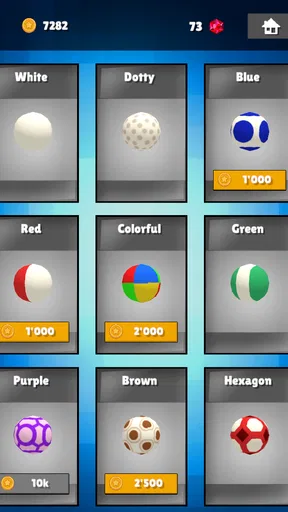
- The game may offer limited customization for balls or player profiles.
FAQs for Mini Golf Game - Putt Putt 3D
What is Mini Golf Game - Putt Putt 3D?
Mini Golf Game - Putt Putt 3D is a casual sports game focused on miniature golf across colorful 3D courses. Players aim, adjust the strength of each shot, and try to complete holes in as few strokes as possible. The gameplay is easy to understand, making it suitable for quick sessions, while the changing layouts and obstacles add enough variety to keep progressing enjoyable.
How do you play Mini Golf Game - Putt Putt 3D?
To play, you generally swipe or drag to choose the direction and power of your putt, then release to hit the ball. The main challenge is judging angles, slopes, barriers, ramps, and moving or fixed obstacles. Taking time to study the course usually produces better results than simply hitting as hard as possible, especially on later and more complicated holes.
Is Mini Golf Game - Putt Putt 3D suitable for beginners?
Yes, the game is approachable for beginners because its controls are simple and the objective is immediately clear. New players can learn the basic aiming and power mechanics within a few attempts. However, getting consistently low scores requires practice, since small changes in shot strength or direction can send the ball away from the ideal route and add unnecessary strokes.
Can Mini Golf Game - Putt Putt 3D be played offline?
Offline availability can depend on the version installed and the feature being used. Basic course play may work without a continuous internet connection, but advertisements, updates, cloud features, leaderboards, or other online services may require access to the internet. It is best to check the app-store description and test the game after installation if offline play is important to you.
Does Mini Golf Game - Putt Putt 3D contain ads or in-app purchases?
Many free mobile mini-golf games use advertising to support development, and this title may display ads between rounds or after completing certain actions. Some versions can also include optional purchases, such as removing advertisements or unlocking additional content. Before downloading, review the current Google Play or App Store listing for the latest information about ads, purchases, permissions, and pricing.


